CLIMATE GOALS ADDENDUM 3 (2026)

Climate Goals. Winning the challenge of climate goals through the creation of skills and competences worldwide
2026 EDITION
ADDENDUM 3
FOCUS GERMANY, THE NETHERLANDS AND POLAND
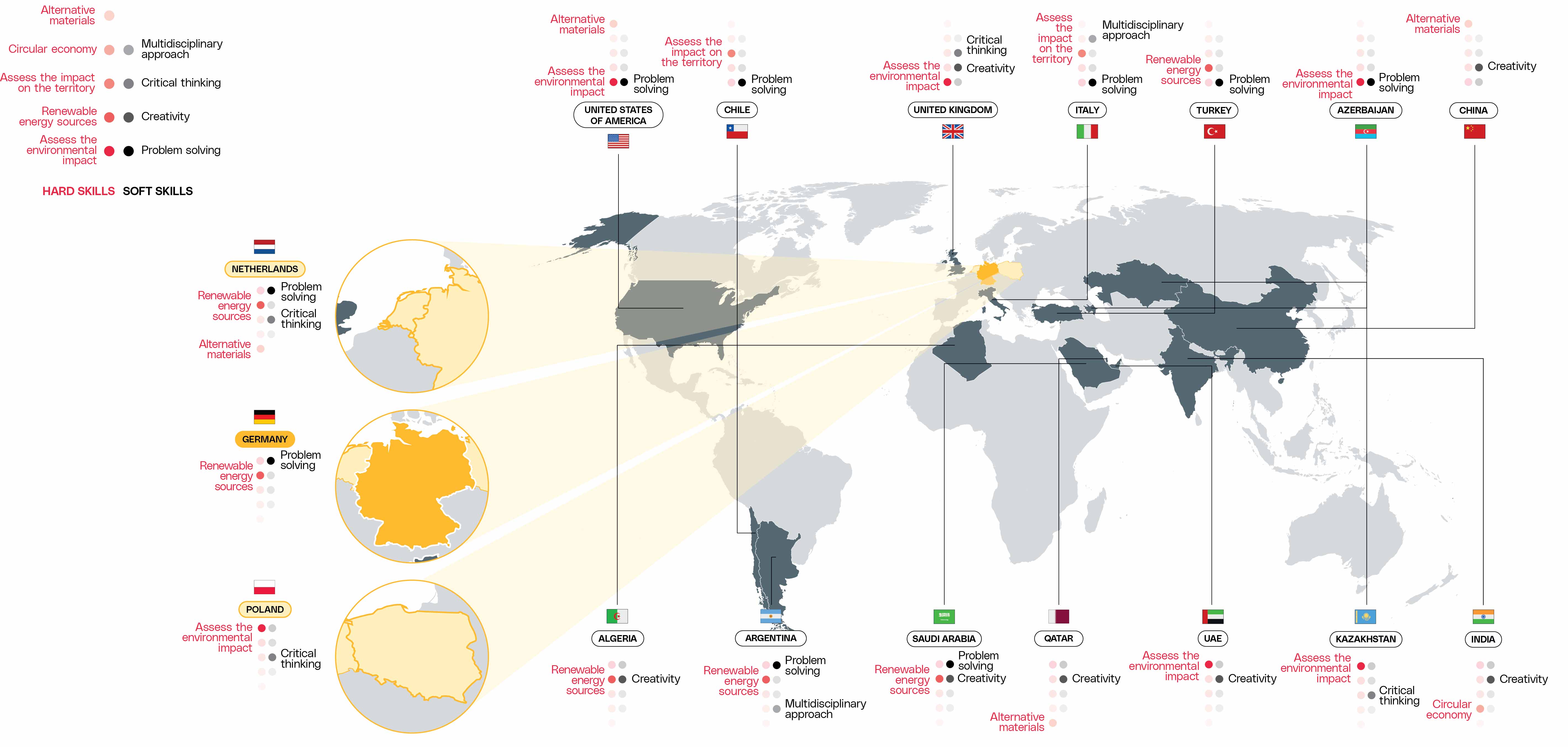
Our international research on the demand for skills related to the energy transition continues, adding a European focus in 2026 with three new countries — Germany, the Netherlands, and Poland — and bringing the total panel of respondents to 17 countries across four continents, with 2,850 interviews (and 25 in-depth discussions with experts): Qatar, Saudi Arabia, and the United Arab Emirates for the Middle East; India, China, Azerbaijan, Kazakhstan, and Turkey for Asia; the United States, Chile, and Argentina for the Americas; Algeria for Africa; and Germany, Italy, Poland, the Netherlands, and the United Kingdom for Europe.
The Fondazione MAIRE – ETS, with the sponsorship of MAIRE Group, in the research conducted by Ipsos Doxa, brings to the table of dialogue the perceived urgency of the creation and upskilling of competences that are necessary to reach climate goals.
The 2026 edition brings with it the publication of three separate papers, each containing a dedicated focus on each new added country.
The first paper focuses on Germany, which stands out for its high level of awareness regarding the energy transition and for its pragmatic approach, viewing change as both an environmental necessity and an industrial evolution.
The second is the one about The Netherlands, which stands out as one of the most mature European markets but also one of the most demanding in evaluating the energy transition: not a technological change, but a broader economic and industrial transformation, shaped by financial innovation and circular models.
The third concerns Poland, one of the European countries where the energy transition is not rejected, but rather examined through a highly rational lens, in which climate targets must be balanced against socio-economic stability, the cost of decarbonisation and the need to protect strategic industrial sectors.
The 2026 results of the study confirm nevertheless the perception that the true engine of the energy transition has shifted away from Europe. Emerging economies are prioritizing the transition as a top-down national mission, sustained by high levels of investment and strong public confidence. China and India are moving faster: they are committing more to education and training for energy transition and expressing stronger confidence in the benefits of the shift. Meanwhile, European countries – Germany, the Netherlands and Poland – are taking a more measured, and in some cases skeptical, approach, especially when weighing priorities and the trade off between costs and benefits.
Click below for more details and to read the paper!
FOCUS ON GERMANY
The first paper, “Climate Goals” Addendum 3 (2026 edition) focuses on Germany.
The survey reveals an extremely interesting international picture.
Germany stands out for its high level of awareness of the energy transition and its pragmatic perspective, seeing the transition as both an environmental necessity and an industrial evolution. Germans perceive the energy transition as a demanding process that requires immediate efforts to unlock future potential, while attention is increasingly shifting to the tangible structural and infrastructural hurdles that must be overcome to complete the process. This vision is supported by a "tripartite" governance model, where responsibilities are shared among politicians, private industry, and citizens. However, private companies are increasingly perceived as the primary drivers of operational progress.
The path forward is viewed as a strictly technical endeavor, rooted in the long-standing excellence of Germany’s energy, engineering and construction, and automotive sectors, that requires the immediate upskilling of the workforce to create "hybrid" professionals combining hard and soft skills.
The main findings of this study were presented on March 26, 2026, during the event “Climate Goals and the Reshaping of Energy. Awareness and Perspectives in Germany” — a MAIRE event held at the Italian Embassy in Berlin.
To learn more, read the dedicated article.
FOCUS ON THE NETHERLANDS
The second paper of “Climate Goals” Addendum 3 (2026 edition) focuses on The Netherlands. The survey reveals an extremely interesting international picture.
The Netherlands emerges as one of the most mature European markets, but also one of the most demanding in the evaluation of the energy transition, perceived not as a technological change, but as a broader economic and industrial transformation, shaped by financial innovation and circular models. The level of awareness is almost unanimous (98%) and 59% declare themselves to be “well informed” on the topic; among the motivations are climate (35%) and public health (30%), while 33% expect a net creation of jobs in sustainable sectors. A positive but realistic vision: 50% believe that in the coming years (from 1 to 3) costs will exceed benefits, to absorb a phase of “initial investments”.
Dutch respondents see business as the main operational driver (57%), while expectations remain high: 43% consider current corporate efforts inadequate. Priority areas align with the perceived strengths of the country: green chemistry (43%), solar and wind (42%), and ICT/digital solutions (33%). Human capital is central: 75% identify a key figure as a “hybrid professional”, capable of combining technical skills (renewables 47% and recycled materials 47%) with advanced cognitive abilities (critical thinking 57%, problem solving 56%) – our “humanist engineer”. While recognizing the need to update skills (70%), the preferred approach is structural and medium-term, with 41% indicating a 2-3 year horizon to integrate new skills.
The main findings of this study were presented on June 18, 2026, in the frame of Nextchem Symposium, during the event “Climate Goals, Awareness & Perspectives” at the Hague.
To read more about the event read the dedicated article.
FOCUS ON POLAND
The third paper, “Climate Goals” Addendum 3 of 2026, focuses on Poland. The survey reveals an extremely interesting international picture.
Poland presents itself as a country where the energy transition is not rejected, but analysed with a highly rational approach, in which climate goals must be balanced against socio-economic stability, the costs of decarbonisation and the need to protect strategic industrial sectors.
58% of respondents say they have only a vague understanding of the energy transition, whilst just 39% consider themselves very well-informed. This helps to explain why the energy transition ranks as the lowest priority among European countries, and indeed among all 17 countries in the panel covered by our research: only 20% of respondents identify it as a top priority, whilst 66% rank it on a par with other key issues. The results highlight a cautious and pragmatic national approach, shaped by concerns regarding socio-economic stability, industrial competitiveness and energy security.
Whilst 25% of respondents fear job losses in traditional sectors, 31% also recognise the potential for creating new jobs in sustainable industries. Responsibility for the transition is perceived as being equally shared between private companies, political institutions and citizens, whilst expectations remain practical: respondents are calling for greater innovation from companies, stronger institutional support for new technologies, and a transition that is evidence-based, well-managed and underpinned by skills development. In this context, training emerges as a key enabler.
The key findings of this study were presented on 11 June 2026 during the 13th Polish Chemical Congress, organised by the Polish Chamber of Chemical Industry (PIPC) in Warsaw. This is the largest and most prestigious annual event for the chemical sector in Poland and Central Europe, bringing together representatives from public administration, industry leaders, the scientific community and companies active across the entire value chain. The presentation of the research findings during the panel discussion “Climate Goals and the Reshaping of Energy: Awareness and Perspectives in Poland” sets the stage for the subsequent discussion on the energy transition in industry, featuring a panel comprising leading industry figures alongside representatives from GasConTec/Nextchem (part of the MAIRE Group) – who will also have a stand at the Congress.
To learn more, read the dedicated article.
CLIMATE GOALS - THE COMPLETE SERIES
In this section, you can find all the reports published since 2023 in the “Climate Goals” series: every year, the research expands to include new countries.
Read them all!
Enhancing the energy transition (2026)
The “Climate Goals” research continues! Addendum 3 of our study on global perceptions of the urgency of implementing the energy transition and developing the new skills required to do so expands the survey to include a European focus, adding three new countries — Germany, the Netherlands, and Poland — and dedicating an in-depth paper to each of them.

Enhancing the energy transition (2025)
The “Climate Goals” research continues! Addendum 2 to our research on the global perception of the urgency of implementing the energy transition and creating the new skills needed to do so integrates the survey by adding two new countries (Qatar and Argentina) and updating the data on the US and China.

Enhancing the energy transition – COP29 (2024)
“Climate Goals” research continues! Addendum 1 of our paper on the perceived global urgency for the creation of new competences for the energy transition has two new protagonists: Azerbaijan and Kazakhstan, looking forward to COP29.

Enhancing the energy transition – COP28 (2023)
“Climate goals.Winning the challenge of climate goals through the creation of skills and competences worldwide”: this is the title of our first research, created to investigate the responsiveness of countries on this theme’ urgency, and presented at COP28 in Dubai in December 2023.